
Polymers in a Spacesuit
Did you know that an astronaut wouldn’t explode in the vacuum of space, but would die within seconds from ebullism — the expansion of gases dissolved in bodily fluids? Nothing like the movies, but just as fatal.
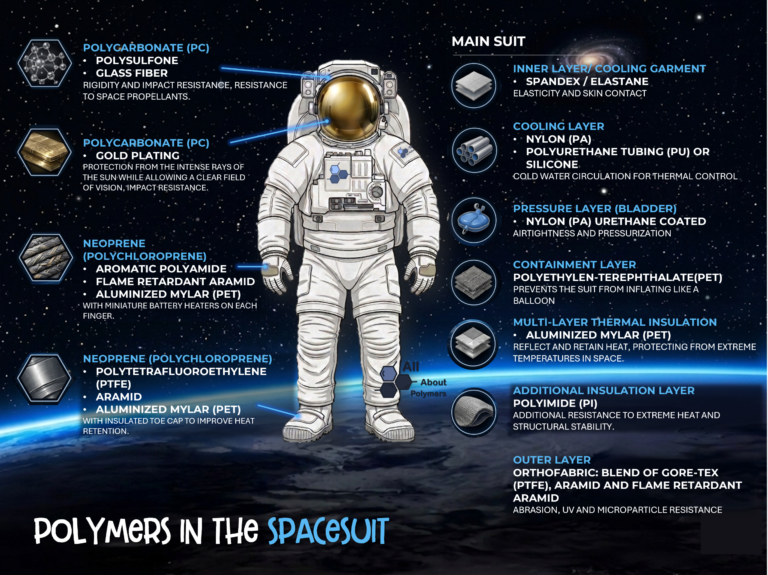
A spacesuit is not clothing. It’s a human-shaped pressure vessel. And the silent heroes making it possible are polymers.
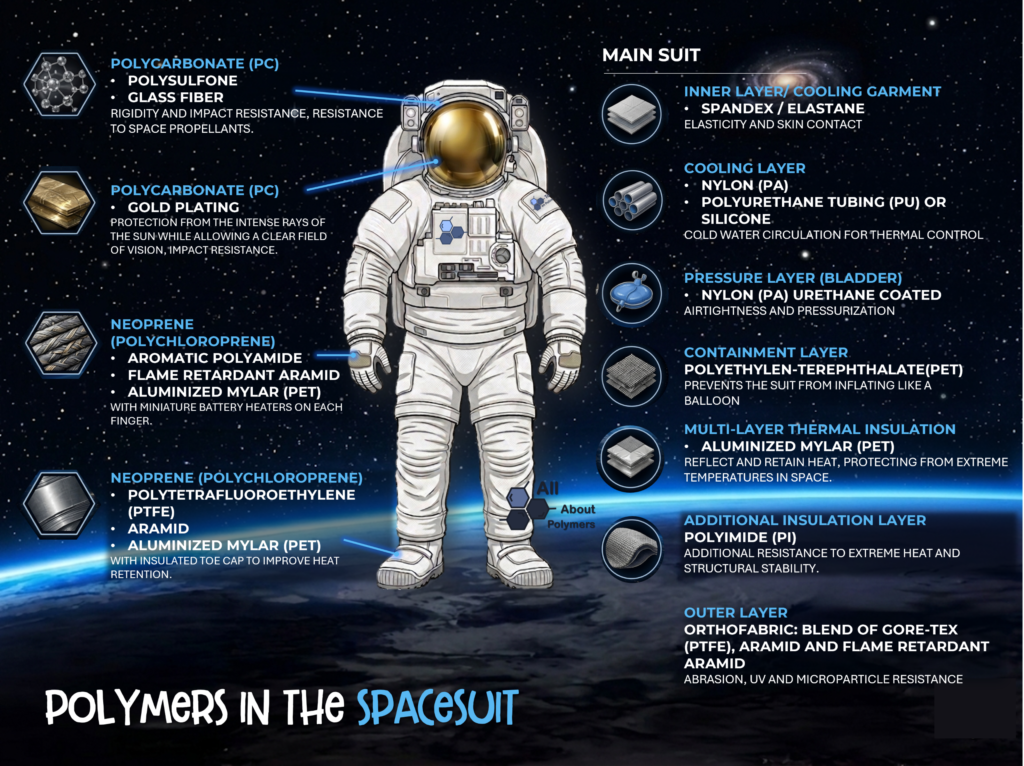
🎈 Nylon (PA) + Polyurethane (PU) → the pressure bladder: as flexible as a second skin, as airtight as a submarine.
🦴 Dacron (high-tenacity PET) → the restraint layer: its high elastic modulus keeps the bladder from ballooning under pressure, preserving the astronaut’s full range of motion.
🛡️ Ortho-Fabric (PTFE + Kevlar + Nomex) → the outer shell: chemical resistance, micrometeorite impact toughness, and extreme thermal stability — all in one composite material.
🕶️ Polycarbonate → the helmet visor: absorbs energy through plastic deformation before fracturing, protecting the astronaut’s face at orbital speeds where even a paint chip hits at 28,000 km/h (17,500 mph).
And on top of that polycarbonate: a 24-karat gold layer just 0.07 microns thick — vacuum-deposited — acts as a thermal mirror and UV filter. The gold isn’t there for aesthetics. It’s there because no polymer alone could do both jobs simultaneously.
The next time you see that iconic golden visor on an astronaut’s helmet, remember: that’s not fashion. That’s materials engineering keeping a human alive at 28,000 km/h.
To learn about polymers, chemistry, and more, visit us at: [www.allaboutpolymers.com]
Our Books: https://allaboutpolymers.com/our-books/
#Polymers #ChemicalEngineering #Spacesuit #Nasa #MaterialsScience #AllAboutPolymers