Types of Polymers
In What Are Polymers? we built a single picture: a polymer is a beaded necklace, with each bead a small repeating unit (a monomer) and the whole strand the polymer itself. That one image is about to do a lot of work, because there isn’t just one way to describe a necklace — and there isn’t just one way to sort polymers.
Think about how you might describe an actual necklace. You could talk about what the beads are made of, how they’re arranged, how the strand behaves when you bend or heat it, or what it’s for. Every one of those is a valid description, and all of them are true at the same time. Polymers work exactly the same way. A single material can be synthetic, crystalline, thermoplastic, linear, and engineering-grade all at once — each label simply answers a different question.
Polymers can be classified in different ways:
• By origin — Natural or Synthetic
• By elasticity — Elastomers or Plastics
• By molecular chain-arrengement — Amorphous or Crystalline
• By thermal behavior — Thermoplastics or Thermosets
• By physical properties — Commodity, Functional, Engineering, or Specialty
• By the variety of repeating units — Homopolymers, Copolymers, or Terpolymers
• By chain shape — Linear, Branched, or Cross-linked
• Bio-Polymers — a special, fast-growing category
Let’s walk through them one at a time.
By Origin: Natural vs. Synthetic
The most intuitive split is simply where the polymer comes from. Natural polymers are made by living things — cellulose in wood and cotton, the proteins in silk and wool, natural rubber from the rubber tree, the DNA in every cell.
Synthetic polymers are built by people in a chemical plant, usually from petroleum or natural gas — polyethylene, nylon, polystyrene, and the rest of the familiar plastics.
We’ll come back to origin in detail in the Bio-Polymers section at the end, because that’s where the line between “natural,” “renewable,” and “biodegradable” gets interesting — and frequently misunderstood.
Elastomers and Plastics
An elastomer is a polymer that stretches a long way and snaps back to its original shape — think of a rubber band, a shoe sole, or a tire. In bead terms, picture a necklace whose beads are loosely strung on a springy thread: pull on it and the whole strand extends; let go and it recoils. That springiness comes from two things working together — viscoelasticity (the material has both viscosity and elasticity) and very weak forces between the chains. The result is a low Young’s modulus (the material is soft and easy to deform) and a very high elongation before it finally breaks, compared with rigid plastics.
A rubber is an elastomer that has been vulcanized (cross-linked, usually with sulfur and heat) to lock in that snap-back behavior permanently.
Most elastomers are amorphous polymers sitting above their glass-transition temperature, which is what keeps them soft and deformable at room temperature rather than hard and brittle.
“A single material can be synthetic, crystalline, thermoplastic, linear, and engineering-grade all at once — each label simply answers a different question.”
Amorphous and Crystalline Polymers
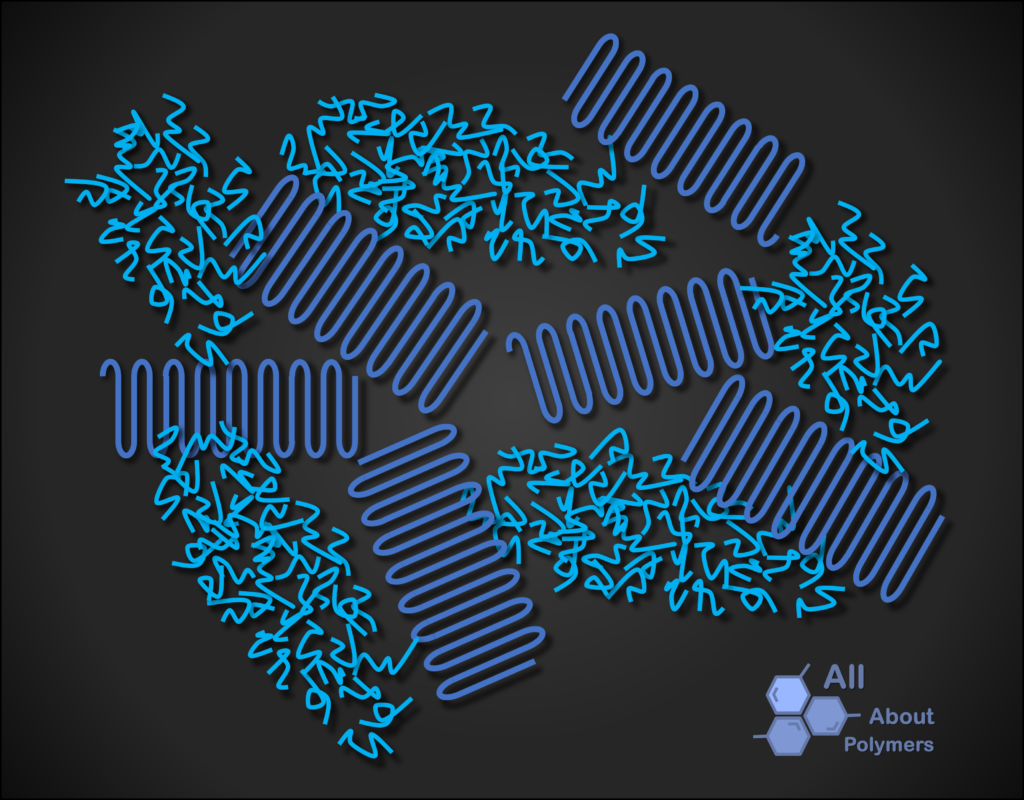
If we could see a polymer’s molecular chains in the liquid (molten) state, we’d find them fully stretched out and relaxed. It’s when they cool and solidify that these chains may — or may not — seek to arrange themselves, and that single difference is what separates these two families.
Resins that don’t seek any arrangement as they solidify — that freeze in place without order — are the ones we call amorphous (from the Greek a-, “without,” and morphos, “form”). It’s this disorder that defines their physical properties. Amorphous resins are mostly transparent, though the reason is a little more subtle than light slipping through gaps left between the chains: because there are no ordered regions to scatter it, light passes straight through the uniform, disordered structure. They also have excellent dimensional stability — with the chains not settling into any arrangement, there’s little adjustment or shrinkage in molded parts. They don’t have a defined melting point, just a gradual softening range, and — polycarbonate aside — they generally don’t offer outstanding mechanical properties.
Examples of amorphous resins are: polycarbonate, styrene acrylonitrile (SAN), and polymethyl methacrylate (PMMA) — better known as acrylic or Plexiglas.
A crystalline resin does the opposite: as it solidifies, its chains seek to form ordered structures called crystallites, and under a microscope you could actually see that molecular arrangement. Crystalline resins are opaque — and here too the real reason is light scattering: those ordered regions scatter light at their boundaries, so it can’t pass cleanly through.
The orderly packing comes with consequences. Crystalline polymers shrink significantly as those crystallites form, which means processing has to account for it to avoid problems like sink marks and warping. In return, they typically reward you with good mechanical and thermal properties and a sharp, defined melting point.
Examples of crystalline resins are: polyethylene (PE), polyoxymethylene (POM or acetal), and the polyamides (PA) — better known as nylon.
Thermoplastics and Thermosets
This classification is about what happens when you heat the material — and it’s one of the most important distinctions in all of plastics, because it decides whether a part can be remelted and recycled.
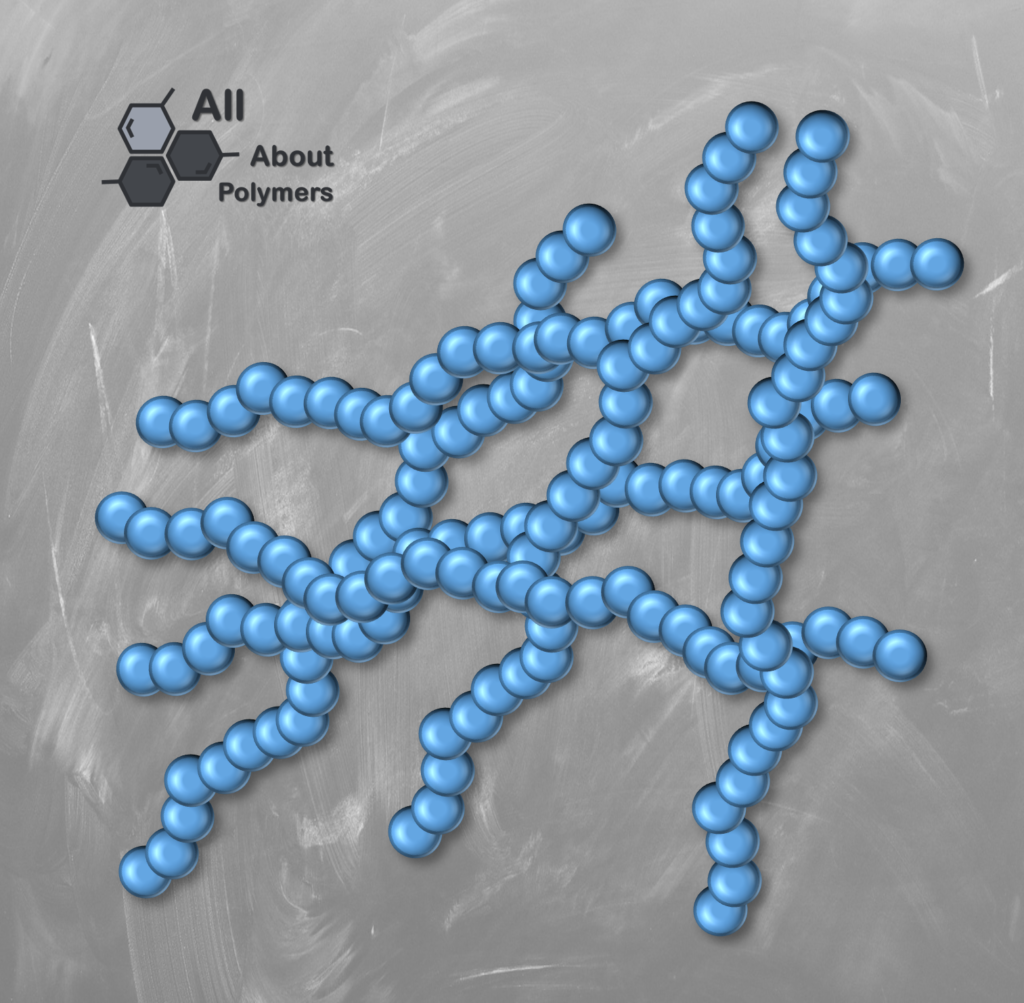
A thermoplastic softens and melts when heated and hardens again when cooled, and you can repeat that cycle. This is, melt it, mold it into a new shape, melt it again. Most thermoplastics are high-molecular-weight polymers, and most everyday plastics — polyethylene, polypropylene, PET, nylon — belong here.
There is a catch worth knowing: each melt-and-mold cycle adds to the material’s thermal history, and properties tend to degrade gradually with repeated processing as bonds weaken or break. So, a thermoplastic can be reprocessed, but not infinitely without some loss.
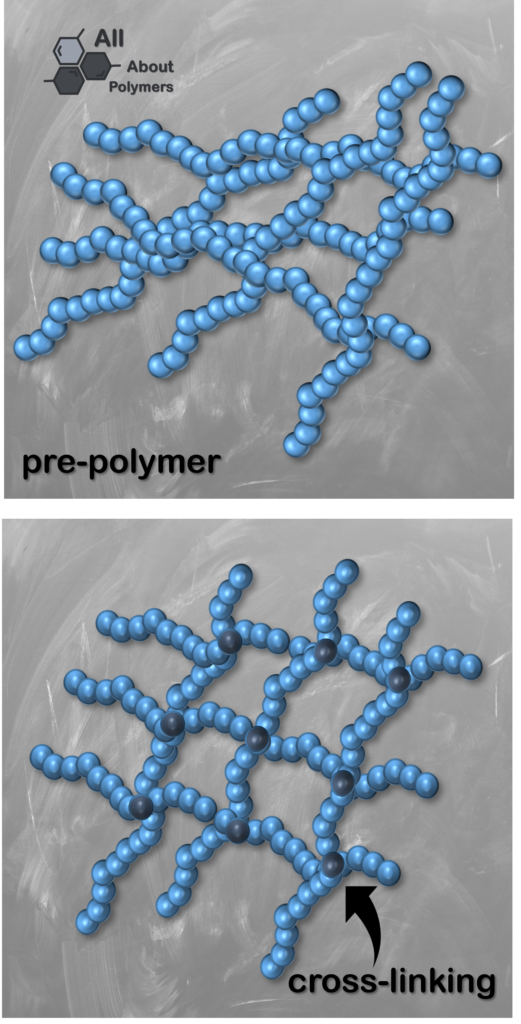
A thermoset (also called a thermo-fixed or thermosetting polymer) behaves very differently. Its base resin can actually soften and flow when heated — that’s how it’s shaped — but during the transformation process (injection or extrusion, for example) it enters together with a second component, generally a catalyst or hardener that reacts chemically with the base resin. That reaction either links the chains in all three dimensions through strong covalent bonds — a process called cross-linking — or transforms the original material into a new one altogether. Once the reaction has taken place, the part is set for good: reheating won’t melt it back into a moldable form. The structure simply packs tighter, grows more rigid, and eventually degrades or burns. That chemical reaction during processing is precisely why a thermoset can’t be re-melted and reprocessed the way a thermoplastic can.
Examples: Bakelite (phenol formaldehyde, found in vintage electrical fittings and pot handles), epoxies, and silicones.
Before this reaction, a thermoset is called a pre-polymer, and at that stage it flows much like an ordinary thermoplastic — it’s the curing reaction that changes everything.
One last point worth knowing: the boundary between these two families isn’t absolute. Some thermoplastics can be deliberately cross-linked, which converts them into thermosets. Polyethylene (PE) and ethylene vinyl acetate (EVA), for example, cross-link when they react with peroxides — and those cross-linked grades are all around us, in everyday applications such as the insulating jackets on electrical cables and the foam soles of footwear.
“Each melt-and-mold cycle adds to the material’s thermal history, and properties tend to degrade gradually with repeated processing as bonds weaken or break.”
Linear, Branched, and Cross-linked Polymers
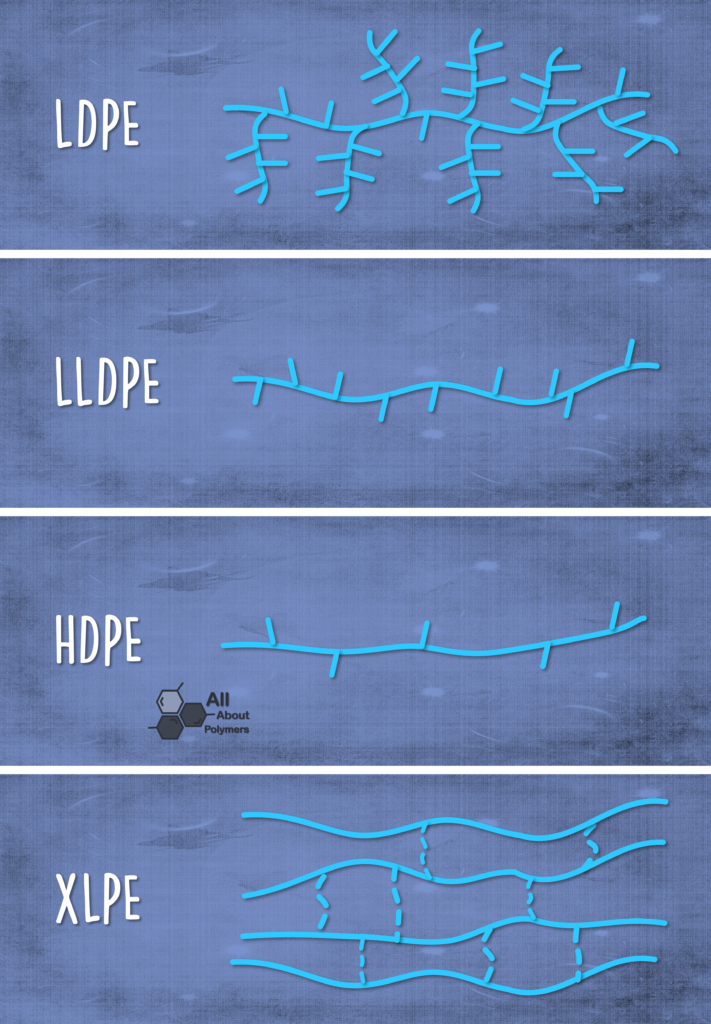
Polymers can also be sorted by the shape of their chains — how complex the strand is. This is where the necklace analogy is at its most literal.
• Linear polymers are a single backbone — one straight strand of beads, with only small groups (a hydrogen, a methyl group, a hydroxyl, and so on) attached along the way.
• Branched polymers have smaller side-strands sprouting off the main strand, like shorter bead-strings tied onto the necklace at intervals.
• Cross-linked (reticulated) polymers have separate strands bonded to one another, tying the whole thing into a connected net.
A great real-world illustration is polyethylene: low-density polyethylene (LDPE) is heavily branched, while high-density polyethylene (HDPE) has almost no branches at all — and that difference in shape is closely tied to how amorphous or crystalline each one turns out to be.
Cross-links make a polymer more rigid. They’re usually created through a chemical reaction with a catalyst and heat — as in vulcanizable or curable elastomers and in thermosets. A few thermoplastics even manage heat-reversible cross-linking, such as the ionomer resins.
Commodity, Functional, Engineering, and Specialty Polymers
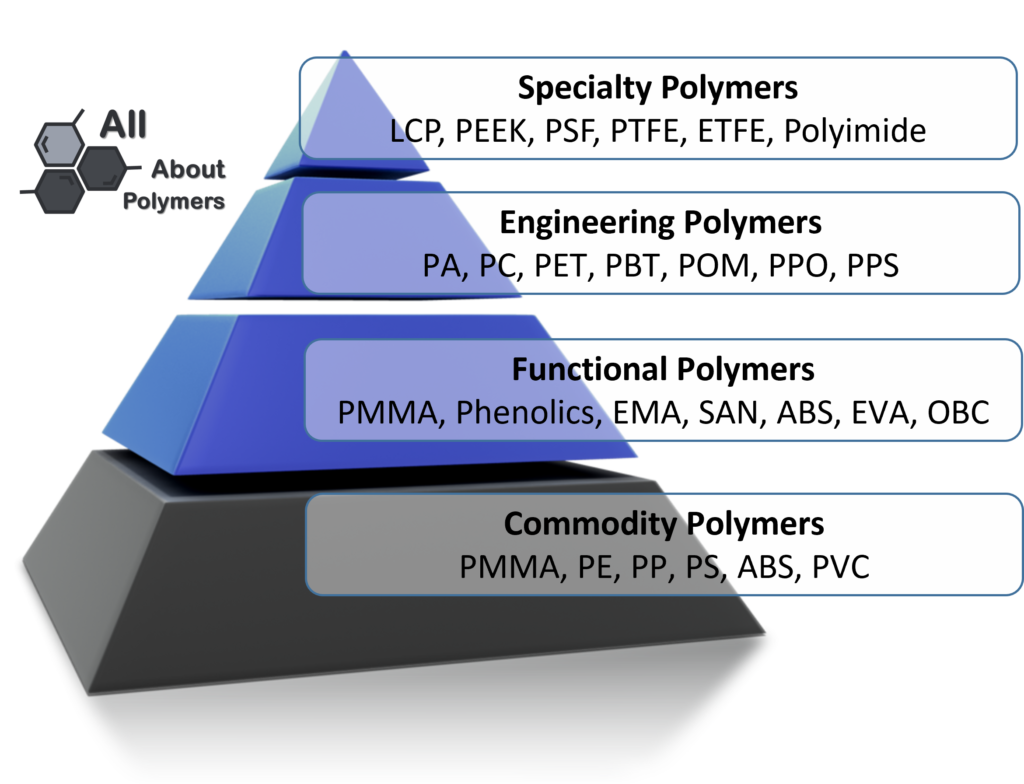
This form of classification ranks polymers by the performance they deliver, and it’s often drawn as a pyramid — the higher you go, the more demanding (and more expensive) the material.
• Commodity polymers sit at the base: the simplest and most widely used, with basic physical properties. Think polyethylene (PE) and polypropylene (PP) — grocery bags, bottles, packaging.
• Functional polymers don’t necessarily have high-end mechanical properties, but they offer one useful advantage over a commodity plastic. Polycarbonate brings outstanding impact resistance; ethylene vinyl acetate (EVA) seals packaging better than plain polyethylene.
• Engineering polymers offer excellent, dependable physical properties and are a step up in capability. Examples include the polyamides (PA / nylon), polyoxymethylene (POM / acetal), and engineering-grade crystalline polyethylene terephthalate (PET).
• Specialty polymers are at the very top: the highest mechanical, thermal, or chemical resistance — or a unique combination — and they’re synthesized or formulated in very particular ways. Liquid-crystal polymers are a classic example.
Homopolymers, Copolymers, and Terpolymers
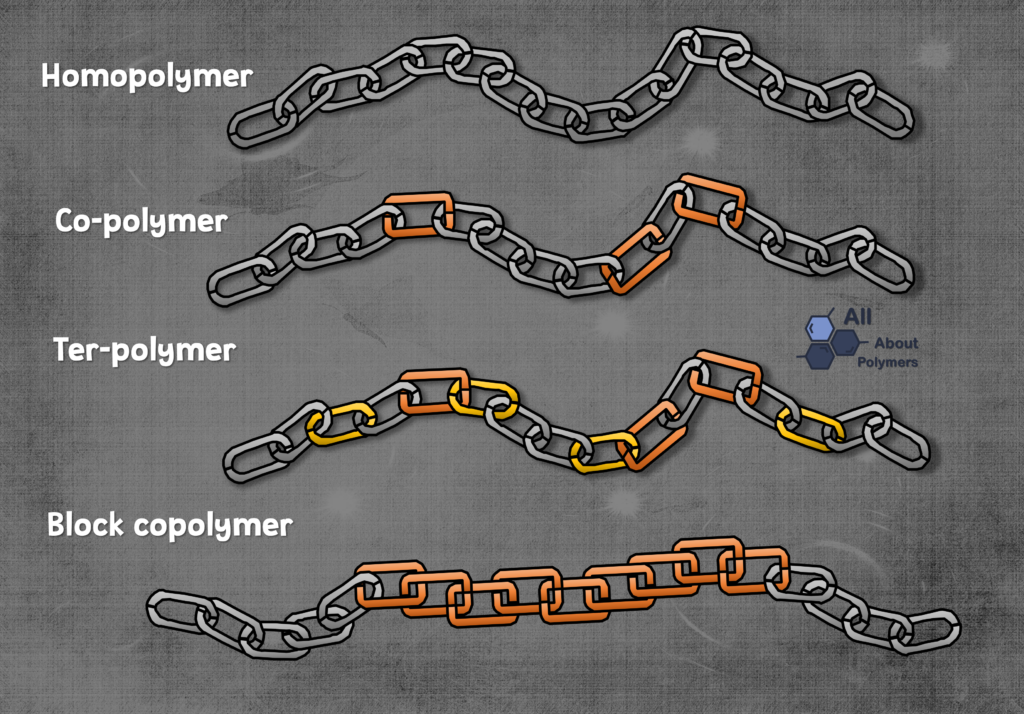
This one falls right out of the necklace example we have been using, and it’s the foundation for understanding more advanced materials later on.
• A homopolymer is built from a single kind of repeating unit — one bead color all the way down the strand. Polyethylene, made only from ethylene monomers, is a homopolymer.
• A copolymer mixes two repeating units — two bead colors on the same strand. Ethylene vinyl acetate (EVA), made from both ethylene and vinyl acetate monomers, is a copolymer.
• A terpolymer uses three repeating units — three bead colors. (ABS is the textbook example.)
Each monomer offers different properties to the polymer, for example, in the case of EVA, the ethylene offers crystallinity and stiffness while the vinyl acetate offers a balance of amorphous structure and flexibility to the polymer.
In the case of copolymers and terpolymers, they can be designed with different molecular arrengements or patterns, from alternated, random, in blocks or grafted, this, to offer a wider range of properties.
Bio-Polymers
Over the past 50 years, polymer production has grown more than twentyfold, and global plastics output now exceeds 400 million tonnes per year.
Plastics are genuinely important materials, and they contribute to environmental protection in ways that aren’t always obvious. Compared with the alternatives in typical applications, the British Plastics Federation reports that plastics can:
• reduce energy costs by up to 40%
• reduce waste by 75–80%
• reduce emissions by 70%
• reduce water pollution by up to 90%
Even so, concern over fossil-resource depletion and pollution has driven a major effort to replace conventional petroleum- and gas-based plastics with polymers built from renewable resources such as biomass. This is where terminology gets slippery, so it’s worth slowing down.
Degradable, Biodegradable, and Compostable — Three Different Things
These three words get used interchangeably in everyday speech, but they mean genuinely different things. Getting them straight is the single most useful thing on this page.
Degradable: A plastic is degradable when its molecules break down enough to cause a significant change in its original properties — regardless of how that breakdown happens. There’s no requirement that living organisms be involved. Oxo-degradable and photodegradable plastics, which break apart on exposure to oxygen or light and are mostly oil-based, are examples.
Biodegradable: Biodegradation is the breakdown of a plastic caused, at least in part, by living cells — microorganisms that ultimately convert the material into water, carbon dioxide, biomass, and possibly methane. Crucially, a polymer’s ability to biodegrade depends on its chemical structure, not on where its raw material came from. Some bio-based plastics biodegrade (polyhydroxyalkanoates, for instance); others don’t (polyethylene made from sugarcane is chemically identical to petroleum polyethylene and just as persistent). Some biodegradable polymers break down in a few weeks; others take months.
Compostable: To qualify as compostable, a plastic must meet all of the following:
• Be biodegradable — breaking down into CO₂, water, and biomass, with 90% of the organic material converted to CO₂ within six months.
• Disintegrate — after three months in compost, it must pass through a 2 mm sieve, with no more than 10% residue remaining.
• Pass eco-toxicity — the biodegradation must produce no toxic material, and the resulting compost must be able to support plant growth.
So the categories nest in a specific way: a plastic can be degradable but not biodegradable, or biodegradable but not compostable (it breaks down too slowly, or leaves toxic residue).
“Degradable, Biodegradable, and Compostable are three words get used interchangeably in everyday speech, but they mean genuinely different things.”
Where Biodegradable Polymers Are Used
Compared with everyday commodity plastics, biodegradable polymers are still a niche market, with focused applications across several sectors:
• Medical devices — orthopedic and dental implants, drug delivery, and tissue engineering
• Agriculture — mulch films, plant pots, and controlled-release fertilizer coatings
• Packaging — carrier bags, waste bags, and food packaging and containers
“Bioplastic” — A Word That Causes Confusion
Beyond crude oil, natural gas, and coal, plastics can also be made from renewable sources like wood (cellulose), vegetable oils, sugar, and starch. These often get called “biological” plastics, “biopolymers,” or “bioplastics.”
The trouble is that these terms are used loosely, and they blur two completely different ideas:
1. The source of the material — is it made from renewable resources?
2. The function — is it biodegradable and/or compostable?
A single material can satisfy one of these and not the other, which is exactly why the labels mislead consumers — especially at the end-of-life stage, where it matters most. For this reason the British Plastics Federation prefers to avoid the words “biopolymer” and “bioplastic” except where necessary, replacing them with two more precise terms:
Natural Bio-Based Polymers: Synthesized by living organisms essentially in the form they’re ultimately used. Examples include polysaccharides (cellulose, starch), proteins, and bacterial polyhydroxyalkanoates. After extraction and purification, they can be used industrially more or less directly.
Synthetic Bio-Based Polymers: Polymers whose monomers come from renewable resources but which require a chemical transformation to become a polymer. Corn starch, for example, can be hydrolyzed and fermented into lactic acid, which is then chemically processed into polylactic acid (PLA). PLA’s raw material is renewable, but the polymer itself can’t be called “natural” — it’s synthesized in a chemical plant.
One Polymer, Different Classifications
Here’s the thread that ties it all together: the polymer hasn’t changed — only the question you’re asking about it has. A grocery bag is synthetic, made of a commodity polymer, that happens to be thermoplastic, linear, and a homopolymer. None of those labels competes with the others; each one tells you something different about the same strand of beads.
That’s the real value of knowing the categories. Once you can read a material the way you’d read a necklace — what it’s made of, how the beads are arranged, how it behaves with heat, what it’s for — the properties stop being a list to memorize and start being a story you can follow.
Sources
• European Bioplastics
• British Plastics Federation
• Wiley — Encyclopedia of Polymer Science and Technology
• Global production figure (>400 million tonnes/year): industry data, 2024