
Blow Molding Processes
Pick up the nearest plastic bottle — water, soda, shampoo, milk — and notice what it really is: a thin, hollow shell wrapped around empty space, light enough to crush in one hand yet strong enough to hold a liter without leaking. How do you make something that’s mostly air?
In Molding Processes and Extrusion Processes we followed the stages a plastic resin goes through on its way to becoming a finished part or profile. But there’s a third variable we haven’t touched yet: blowing the part — inflating it with air during or just after shaping, while the polymer is still molten. This is known as blow molding.
Blow molding is a manufacturing process for forming hollow parts with thin, uniform walls. In general, there are four main types of blow molding:
- Extrusion Blow Molding (EBM)
- Injection Blow Molding (IBM)
- Injection Stretch Blow Molding (ISBM)
- Blow, Fill and Seal (BFS)
Inspired by Glass
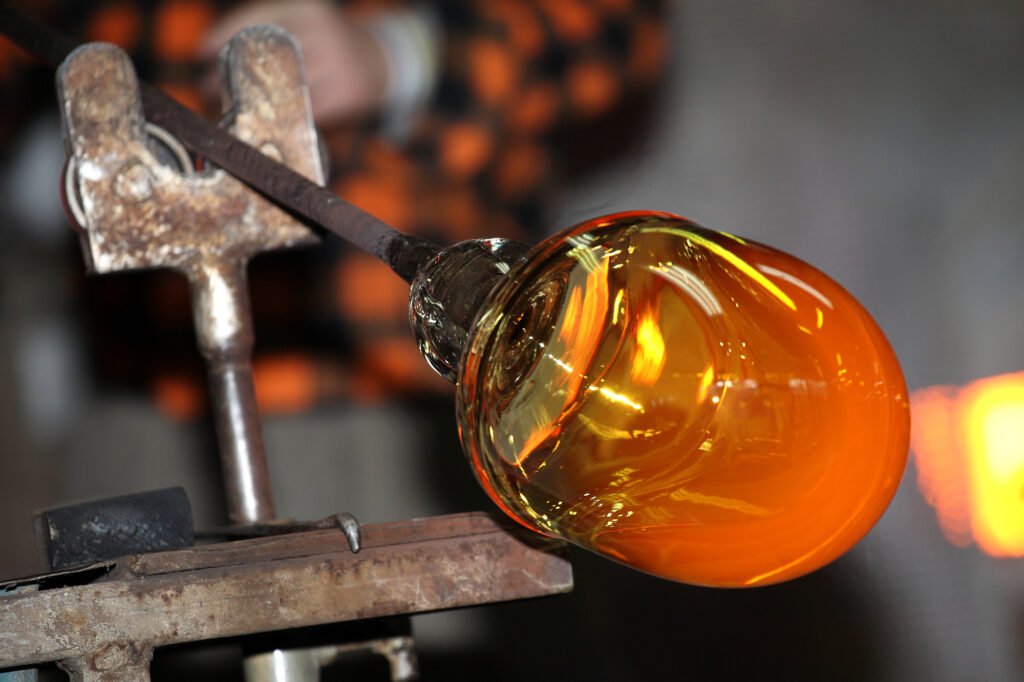
The principle behind these processes comes from the idea of glass blowing. Ferngren and Kopitke developed a blow molding machine and sold it to the Hartford Empire Company in 1938. This was the beginning of the commercial blow molding process. Through the 1940s the variety and quantity of products was still limited, so blow molding grew slowly at first; it gained real momentum only later, as the range and speed of production improved and the number of products being made grew with them.
The technical mechanisms needed to produce hollow parts by blowing were established very early on. Because glass is so fragile, plastic was used to replace it in some applications after it was introduced. The first mass production of plastic bottles took place in the United States in 1939. Germany began using the technology a little later, but today it is one of the leading manufacturers of blow molding machines.
In the U.S. soft drink industry, the number of plastic containers went from zero in 1977 to ten billion units in 1999.
Extrusion Blow Molding (EBM)
Extrusion Blow Molding, or EBM, is a variant of the Extrusion Process and is the simplest type of blow molding. A hot tube of molten plastic (better known as a parison) is dropped from an extruder and captured in a water-cooled mold. Once the molds are closed, air is injected through the top or the neck of the part to be molded — much like inflating a balloon. As the hot plastic is blown and meets the mold walls, it cools and the part holds a rigid shape.
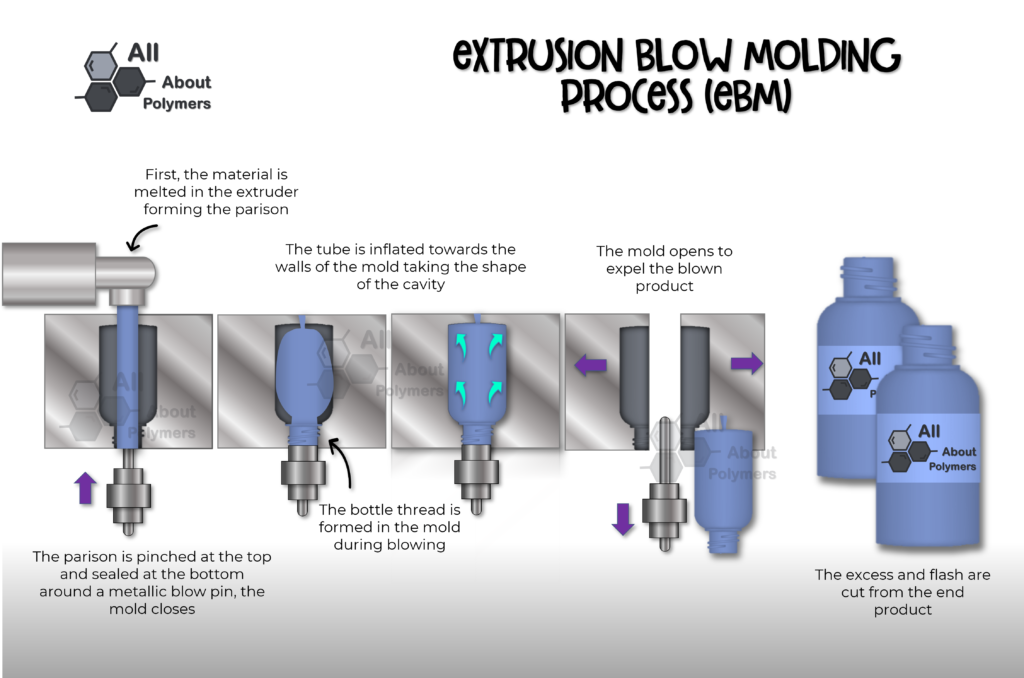
Extrusion blow molding allows a wide variety of container shapes, sizes, and neck openings, as well as the production of parts with a handle or grip. Output can range from hundreds to thousands of bottles per hour, depending on the type of machine and the size of the part.
The weight of parts made by extrusion blow molding can be adjusted across an extremely wide range. Molds for extrusion blow molding are generally far less expensive than injection blow molds, and they can be made in a much shorter period of time.
Examples of parts made by the extrusion blow molding process include most hollow polyethylene products, milk bottles, shampoo bottles, automotive ducts, and hollow industrial parts such as drums.
The advantages of extrusion blow molding include a high production rate, low tooling cost, and a wide variety of machine manufacturers. It requires a relatively small capital investment in equipment and is well suited to short production runs.
“How do you make something that’s mostly air?”
Some disadvantages generally include a high scrap rate, limited control over wall thickness, and some difficulty trimming the excess plastic.
Extrusion blow molding can be used to process many different plastics, including HDPE, PVC, PC, PP, and PETG.
As with co-extrusion, extrusion blow molding can be mono-layer or multi-layer: different extruders feed a single die to form a structure with several layers. This is very useful when you need to increase the oxygen barrier, combine chemical resistance with transparency, and so on.
Injection Blow Molding (IBM)
Injection Blow Molding, or IBM, is part Injection Molding and part blow molding. It is generally suited to fairly small containers and does not allow parts with a handle. It is often used for containers with tight tolerance ranges on threaded necks, wide-mouth openings, solid handles, and highly stylized shapes. Blown containers usually have a programmed weight that cannot be changed easily. The container material is generally distributed evenly, and no trimming or milling is usually needed. Air is injected into the plastic at a pressure of 75 to 150 PSI.
In the IBM process, the polymer is injection molded over a core — usually pin-shaped — to form the preform; this pin core is then rotated to the blow station to be blown and cooled. This is the least used of the three blow molding processes, and it is typically used to make small medical bottles or single bottles. The process breaks down into three steps: injection, blowing, and ejection.
The injection blow molding machine includes an injection unit to melt the polymer. The molten polymer is fed to a hot runner manifold, where it is injected through nozzles into a hot mold. Inside the mold cavities, the preform forms around a core, usually pin-shaped.
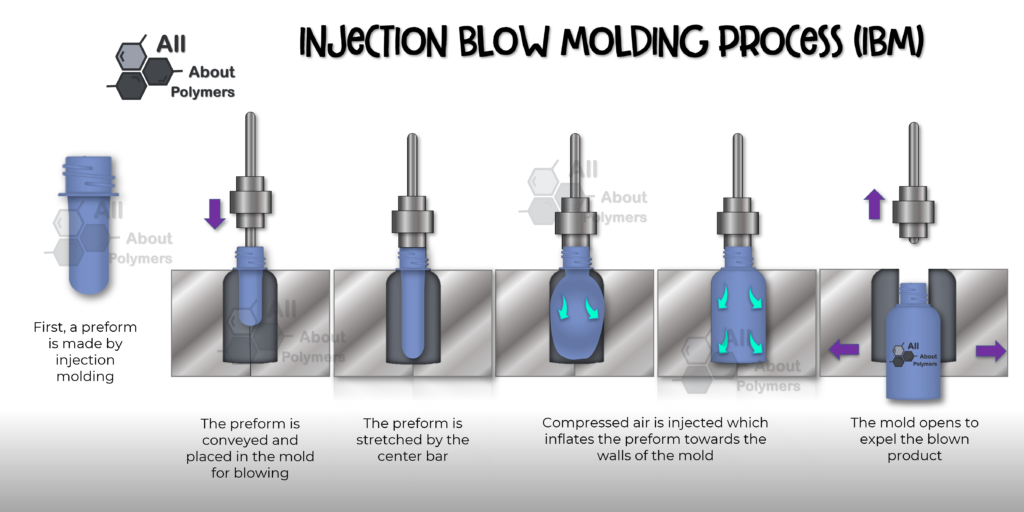
The preform consists of a fully formed bottle or jar neck attached to a thick tube of polymer that will form the body — similar in appearance to a test tube with a threaded neck.
The preform mold opens and the central bar rotates and is clamped into the hollow, cooled blow mold. The tip of the bar opens, allowing compressed air into the preform, which inflates to the shape of the final article.
After a cooling period, the blow mold opens and the bar rotates to the ejection position. The final article is ejected and, optionally, can be leak-tested before packaging. The molding and blow molds can have many cavities — generally three to sixteen, depending on the size of the article and the production required. There are three sets of bars that allow injection, blowing, and ejection.
Injection Stretch Blow Molding (ISBM)
Injection Stretch Blow Molding is best known for producing the PET bottles commonly used for water, juice, and a variety of other products. Stretch blow molding has been used since the early 1970s — especially for detergent packaging — and has grown steadily, with its main use now in manufacturing carbonated beverage bottles.
One of the main advantages of stretch blow molding is the ability to stretch the preform both circumferentially and axially. This biaxial stretching of the material increases tensile strength, barrier properties, drop impact resistance, clarity, and the load the container can carry. With these gains it is usually possible to reduce the total weight of a container by 10 to 15 percent compared with other production methods.
Stretch blow molding falls into two different categories: single-stage and two-stage.
“One of the main advantages of stretch blow molding is the ability to stretch the preform both circumferentially and axially. ”
The single-stage process uses the injection unit to inject material into a mold, where the plastic cools rapidly to form the preform. The preform is then reheated (conditioned) and placed in the blow mold to form the bottle. This is where the softened preform is stretched to roughly twice its original length. Compressed air is immediately blown into the stretched preform to expand it against the mold walls, forming the bottle. Once the bottle cools, the mold opens and the finished bottle is ejected from the cavity. This technique is most effective in special applications, such as wide-mouth jars, where very high production rates are not required.
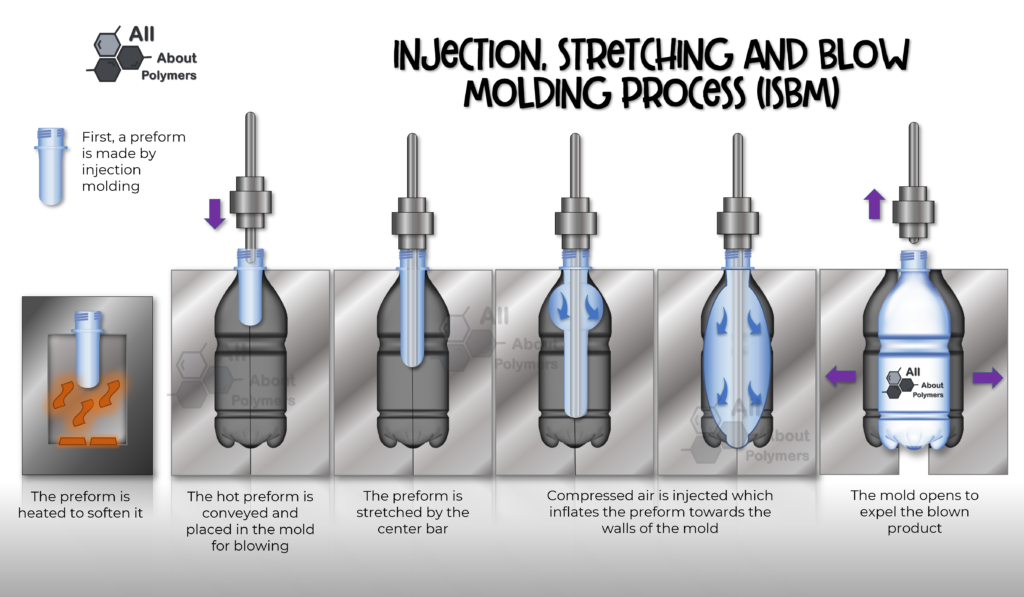
The two-stage process is the same as the single-stage one, except that the preforms are already made. The single-stage process is normally carried out on a single machine, while the two-stage process uses preforms that have already been made and cooled — which lets companies make or buy their own preforms. Because of the relatively high cost of the molding and re-heat blow (RHB) equipment, this is the best technique for high-volume production, such as carbonated beverage bottles. In this process, the machinery injection molds a preform, which is then transferred within the machine to another station where it is blown and then ejected. This process is used for very high-volume runs of items such as wide-mouth peanut butter jars, narrow-mouth water bottles, liquor bottles, and so on.
Blow, Fill and Seal (BFS)
The Blow, Fill and Seal (BFS) process is a manufacturing technique used to produce liquid-filled containers ranging from small (0.1 ml) to large (over 500 ml). Originally developed in Europe in the 1930s, it was introduced in the United States in the 1960s, but over the last 20 years it has become more common within the pharmaceutical industry and is now widely regarded as the primary form of aseptic processing by several regulatory agencies — such as the Food and Drug Administration (FDA) — for packaging pharmaceutical and healthcare products.
The basic concept of BFS is that a container is formed, filled, and sealed in one continuous process with no human intervention, inside an enclosed, sterile area within a machine. This technology can therefore be used for the aseptic manufacture of sterile forms containing a liquid pharmaceutical dose.
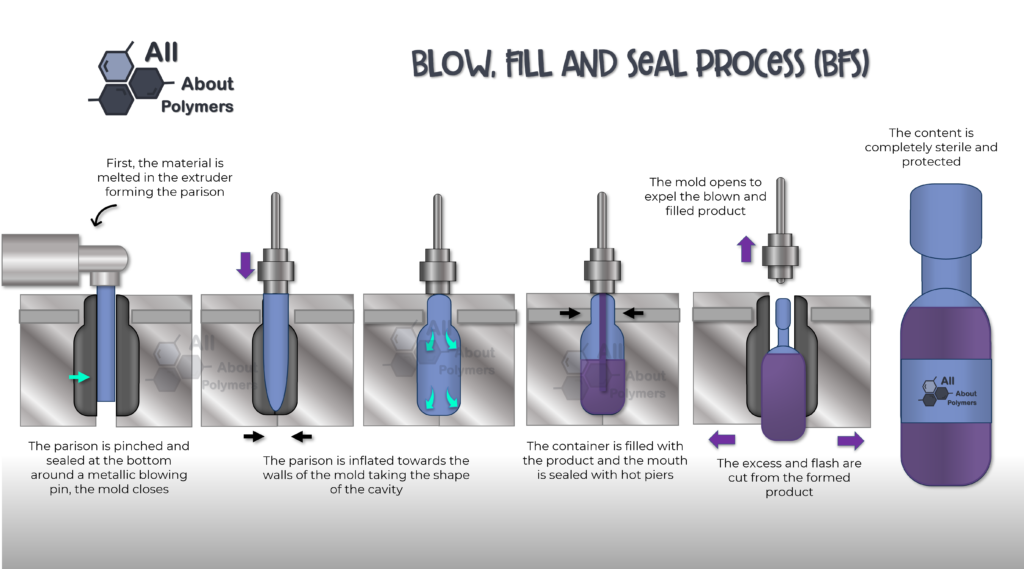
The process consists of several steps. First, pharmaceutical-grade plastic resin is extruded as a parison through a circular die into a mold, and the tube is cut at the top — similar to Extrusion Blow Molding.
The mold is transferred to the filling zone, where the filling needles (mandrels) descend and are used to inflate the plastic to form the container inside the mold. After the container is formed, the mandrel is used to fill it with liquid.
After filling, the mandrels retract and a secondary top mold seals the container. All of these actions take place inside a chamber with a sterile environment within the machine. The product is then discharged to a non-sterile area for labeling, packaging, and distribution.
Blow, Fill and Seal technology reduces personnel intervention, making it a more robust method for the aseptic preparation of sterile pharmaceutical products. BFS is used to fill vials of parenteral preparations and infusions, eye drops, and inhalation products. In general, the plastic containers are made of polyethylene and/or polypropylene. Polypropylene is most commonly used to form containers that are sterilized in an autoclave, because of its superior thermal properties.