The Trionda: More Science Than University
How much chemistry, physics, design, and computing can fit in a soccer ball? The official ball of the 2026 World Cup has more than you’d think.
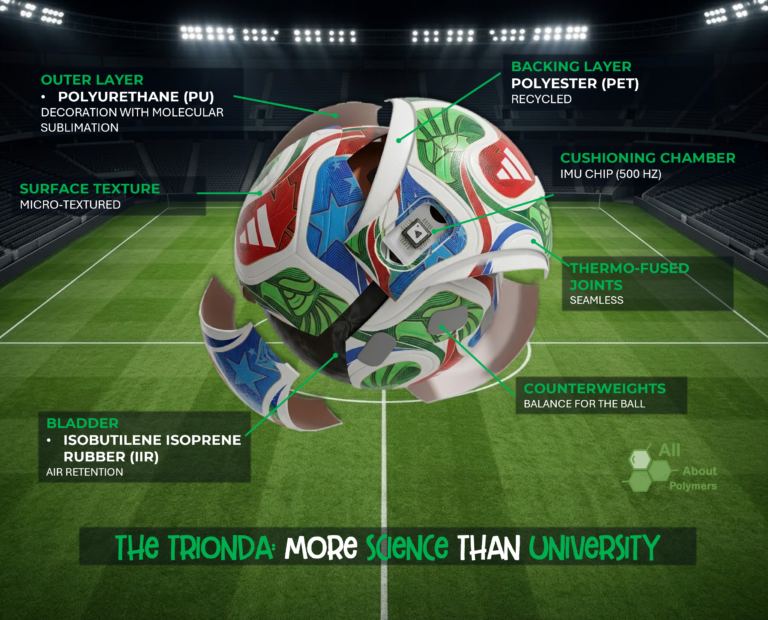
The Adidas Trionda is the official ball of the 2026 FIFA World Cup, the tournament hosted across Mexico, the United States, and Canada. Its name combines “Tri” (three host nations) and “Onda” (wave), evoking movement, energy, and unity. But beyond the design and symbolism, the Trionda is a lesson in materials science disguised as soccer. Here are the key highlights:
🔵 Four panels: the fewest in World Cup history
The Trionda sets a record: it’s the first official World Cup ball built with only four panels. Fewer panels mean fewer seams, fewer surface discontinuities, and a more predictable, stable flight path. The fluid design geometry echoes the waves in the ball’s official name.
⚙️ Seamless bonding: thermal bonding
How is PU joined without needle or thread? Through thermal bonding: the panels are coated with a heat-activated adhesive and placed inside a spherical mold that applies uniform heat and pressure. The result is an almost seamless surface that reduces water absorption, eliminates seam weak points, and improves aerodynamics by minimizing turbulence. One interesting consequence of the process: the ball cannot be deflated, because the bladder is integrated and sealed during molding.
🎨 The outer layer: Polyurethane (PU) printed by sublimation
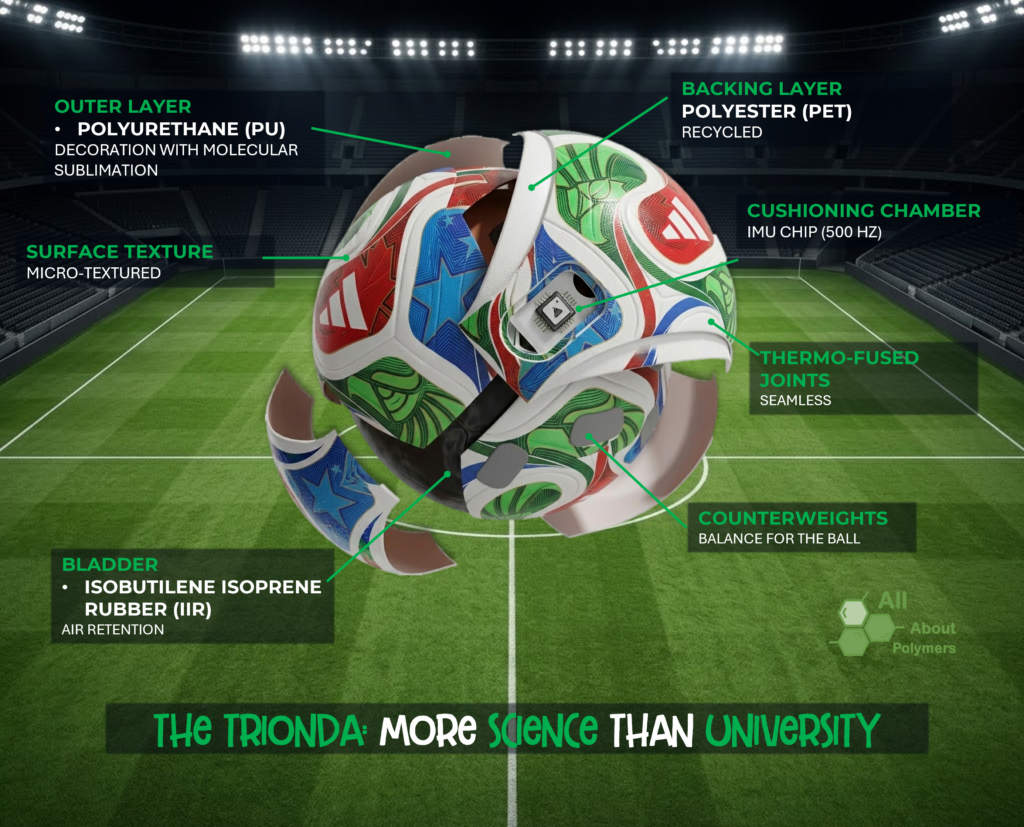
The Pro ball shell is 100% polyurethane, but what’s most interesting is how it’s decorated. The red, green, and blue colors are applied through sublimation: the dye converts to gas under heat and bonds to the polymer chain at the molecular level. The result is a color that cannot scratch or fade — embedded into the very structure of the PU, not sitting on top of it.
♻️ The backing layer: Recycled polyester
Behind the PU shell, the Trionda Pro carries a layer of recycled polyester — post-consumer PET, typically from bottles — that acts as each panel’s structural skeleton: giving it shape, stiffness, and dimensional stability before and during the thermal bonding process. Without this layer, the outer PU would be too flexible to maintain the panel’s precise geometry under mold pressure. It’s also one of the most concrete examples of circular economy in this ball.
🫧 The bladder: Butyl Rubber (IIR)
The bladder is the heart of air retention. The Trionda uses butyl rubber (IIR — Isobutylene-Isoprene Rubber), the elastomer with the lowest gas permeability of all commercial rubbers. Why can’t the air escape? Think of the polymer chain as a road with no exits: the isobutylene units that form the main chain carry no double bonds, making it so compact and rigid that nitrogen and oxygen molecules simply cannot find a path between them. The result is a ball that holds its pressure for weeks — something natural latex rubber cannot match.
Note: butyl rubber (IIR) should not be confused with SBR (Styrene-Butadiene Rubber), which — despite the similar-sounding name — has a completely different composition, structure, and set of applications, primarily tires and shoe soles.
📡 The IMU sensor’s shock-absorbing chamber
The Trionda integrates an electronic sensor called an IMU (Inertial Measurement Unit), capable of precisely recording every movement of the ball: velocity, rotation, and trajectory. It transmits that data 500 times per second to the VAR system, enabling real-time offside detection with almost no margin for error.
The chip doesn’t float freely inside the ball. It sits inside a specially designed shock-absorbing chamber built into one of the four panels, absorbing the impact of every kick and protecting the electronics. The other three panels carry counterweights to keep the ball perfectly balanced in flight. It’s an elegant engineering solution: digital technology fully integrated without compromising the ball’s physical behavior.
The bottom line
From the IIR bladder to the PU sublimation printing, the Trionda is a reminder that behind every great tournament lie decades of materials science. Chemistry, physics, industrial design, and computing — all in a sphere weighing approximately 450 g (about 1 lb). The next time you watch a goal at the 2026 World Cup, you’ll know exactly which polymers made that shot possible. ⚽🧪
To learn about polymers, chemistry, and more, visit us at: [www.allaboutpolymers.com]
Our Books: https://allaboutpolymers.com/our-books/
#Polymers #ChemicalEngineering #WorldCup2026 #AdidasTrionda #MaterialsScience #AllAboutPolymers