What is a Polymer?
Look around you right now. The screen you’re reading this on, the bottle on your desk, the soles of your shoes, the fibers in your clothes — chances are most of them are made of polymers. So is the wood of a pencil, the DNA inside your cells, and the rubber in a car tire. Polymers are one of the most important families of materials on Earth, both the ones nature makes and the ones we make ourselves. So what exactly is one?
Here’s the simplest way to picture it. Think of a beaded necklace: you string one bead, then another identical one, then another, and another, until you have a long strand made of the same small bead repeated thousands — even millions — of times. A polymer is that necklace. Each individual bead is called a monomer, and the long strand they build is the polymer.
The words come straight from Greek and tell the whole story:
– poly = many
– mer = unit, or repeating part
So, a polymer is, literally, “many units” — a chain of repeating units (the monomers, from mono = one) that join and repeat to form a single giant molecule, or macromolecule, that can contain tens of millions of beads. Before we string the necklace together, though, let’s look at what a single bead is actually made of — and for that, we start with molecules.
Starting Small: Molecules and Atoms
A molecule is an electrically neutral group of two or more atoms held together by chemical bonds. (That neutrality is exactly what separates a molecule from an ion, which carries an electrical charge.)
A useful way to think about bonds is to imagine each atom having a certain number of “bonds” available to hold onto other atoms. The three atoms that show up most often in plastics have a very specific number of bonds each:
The three atoms most commonly found in plastic resins are:
• Carbon (chemical symbol C), which forms 4 bonds
• Hydrogen (chemical symbol H), which forms 1 bond
• Oxygen (chemical symbol O), which forms 2 bonds
“A polymer is, literally, “many units” — a chain of repeating units (the monomers, from mono = one) that join and repeat to form a single giant molecule, or macromolecule, that can contain tens of millions of beads.”
One Family, Many Faces
“Polymer” isn’t one material — it’s a huge family with very different members. The main groups are:
• Plastics — the polyethylene in grocery bags and milk jugs, the polypropylene in yogurt tubs and bottle caps, the PVC in pipes.
• Rubbers — the stretchy material in tires, erasers, and wetsuits.
• Fibers — the nylon in backpacks and the polyester in clothing.
What makes one polymer behave so differently from another comes down to four things — and the necklace makes each one easy to picture:
• the type of bead (monomer) you use — beads of a different color or shape give a different necklace, just as different monomers give a different polymer;
• the number of beads you string — a short strand behaves very differently from one with millions of beads;
• the way the beads are joined — loosely or tightly, in a straight line or not;
• and whether extra strands branch off the main one.
Some beads are soft and some are rigid, too. Mix and match those few choices and you can go from a flexible plastic bag to a rigid pipe to a stretchy rubber band — all from the same simple idea of repeating beads.
Where Do Polymers Come From?
Polymers are built from raw materials that come from several different sources. Some are natural — cellulose (the stuff of wood, cotton, and paper), ethanol (better known as ethyl alcohol), natural rubber, and so on. Others are pulled out of fossil resources, which is where most commercial plastics begin.
Natural Gas and Coal
Natural gas is one starting point. From it we get ethylene, which strings together into polyethylene, as well as methane, which becomes formaldehyde — one of the two building blocks of phenolic resins, the other being phenol.
Coal contributes too. From coal tar we get benzene, which converts to phenol and can ultimately become polyurethane and polystyrene. From coke we extract acetylene, which can be used to make ethylene (for polyethylene) and vinyl chloride (for polyvinyl chloride, better known as PVC — the material in pipes and window frames).
Petroleum
Petroleum is the big one. From it we extract naphtha, probably the single most important raw material for making polymers. The diagram below maps out the many products that come from petroleum, including the starting points for several plastics you’d recognize from everyday life.
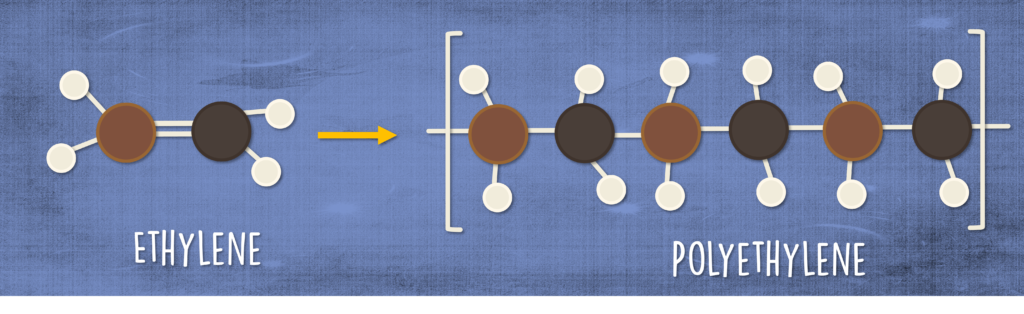
This is where carbon’s four “hands” pay off. Carbon forms the backbone of the chain: it uses two of its hands to link one carbon to the next, leaving two free to hold onto other atoms along the way. Take the ethylene molecule (CH₂=CH₂) below. Put it under the right pressure and temperature inside a reactor, and these small molecules clasp hands and string together into long chains of polyethylene. That bead-by-bead joining is exactly what we call polymerization.
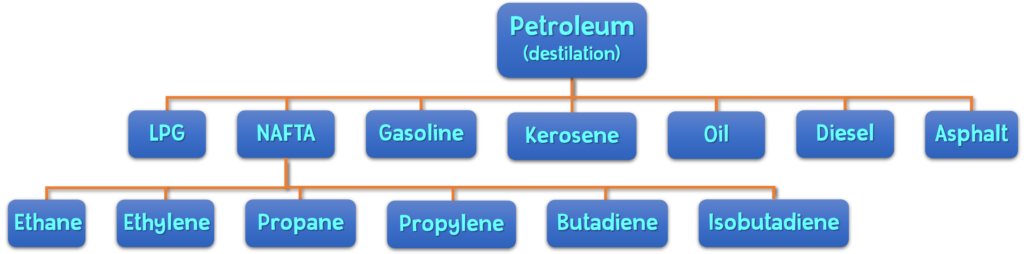
Before any of this can happen, the naphtha has to be broken down. It goes through a process called cracking, which splits its large molecules apart into the simpler building blocks shown in the diagram above.
Polymerization: How the Chain Gets Built
Once you have your monomers — your individual beads — polymerization is the step where they actually join into a chain. There’s more than one way to do that, and the method chemists choose shapes what the final polymer turns out to be. Here are the most common, starting with the plain idea and getting more detailed as we go.
Chain Polymerization
One monomer is “switched on,” and it triggers the neighbor next to it to join, which triggers the next, and so on down the line. It’s fast, and it builds very long, heavy chains quickly. (This is the family the ethylene-to-polyethylene example above belongs to.)
Step Polymerization
Instead of one long chain zipping up at once, monomers pair off into twos (dimers), then those join into fours, then longer pieces, gradually building up to full-length chains. Polyesters, polyamides (nylon), and polyurethanes are made this way.
Interfacial Polymerization
A special kind of step polymerization that happens right at the boundary between two liquids that don’t mix — a water-based solution holding one monomer, and an oily, organic solution holding the other. The classic product is nylon: a diamine and a diacid chloride meet at the interface and react to form the polyamide, with hydrochloric acid as a byproduct.
Bulk Polymerization
Here an initiator or catalyst is mixed straight into a liquid monomer and dissolves in it. Heat or radiation kicks off the reaction. As the chains grow, the mixture thickens; the reaction gives off heat (it’s exothermic) and can produce a wide range of chain lengths.
Emulsion Polymerization
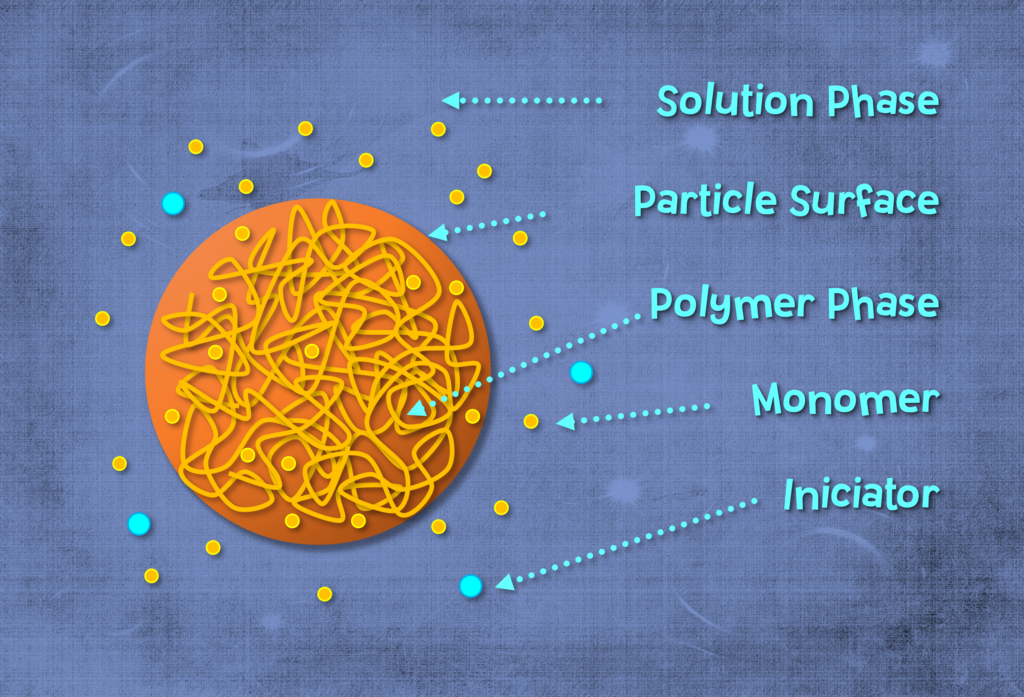
Emulsion polymerization is a type of radical polymerization that usually begins with an emulsion of water, monomer, and a surfactant. The most common form is an oil-in-water emulsion, in which droplets of monomer (the “oil”) are emulsified — with the help of surfactants — in a continuous water phase. Water-soluble polymers, such as certain polyvinyl alcohols or hydroxyethyl celluloses, can also be used as emulsifiers or stabilizers.
The name “emulsion polymerization” is something of a misnomer, the result of a historical mistake. Rather than taking place in emulsion droplets, the polymerization actually occurs in the latex particles that form spontaneously within the first few minutes of the process. These particles are kept from coagulating because each one is surrounded by surfactant (“soap”); the charge on the surfactant repels the other particles electrostatically. When water-soluble polymers are used as stabilizers instead of soap, the repulsion between particles arises because these polymers form a “hairy layer” around each particle that pushes others away — bringing the particles together would mean compressing those chains.
“Once you have your monomers — your individual beads — polymerization is the step where they actually join into a chain.”
How it Works?
- A monomer is dispersed (emulsified) in a solution of surfactant and water, forming relatively large droplets of monomer in water.
- Excess surfactant creates micelles in the water.
- Small amounts of monomer diffuse through the water to the micelles.
- A water-soluble initiator is introduced into the aqueous phase, where it reacts with the monomer inside the micelles.
- Because the total surface area of the micelles is far greater than that of the monomer droplets, the initiator typically reacts in the micelle rather than in the droplet.
- The monomer in the micelle polymerizes quickly and the growing chain terminates. At this point the monomer-swollen micelle has become a polymer particle.
- More monomer from the droplets diffuses into the growing particle, where additional initiator will eventually react.
- Eventually the free monomer droplets disappear, and all the remaining monomer is contained in the particles.
- Depending on the product and the monomer, more monomer and initiator can be added slowly and continuously to maintain their levels in the system as the particles grow.
Many commercially important polymers are made this way. Some are dried out and used as solids; in other cases the liquid dispersion itself is the product. That dispersion is often called a latex (especially when it comes from a synthetic rubber) or an emulsion. Polymers commonly made by emulsion include:
• Styrene-butadiene rubber (SBR) — some grades
• Polybutadiene
• Polychloroprene (Neoprene)
• Nitrile rubber
• Acrylic rubber
• Polyvinyl chloride (PVC) — some grades
• Polystyrene — some grades
• Polymethyl methacrylate, or acrylic (PMMA) — some grades
• Acrylonitrile butadiene styrene (ABS)
• Polyvinylidene fluoride (PVDF)
• Polytetrafluoroethylene (PTFE or Teflon®)
• Aqueous dispersions of polyvinyl acetate, acrylic latex, and the like
Suspension Polymerization
Mechanical stirring keeps droplets of monomer suspended in a liquid (usually water), and as each droplet polymerizes it hardens into a small bead. It’s used to make several familiar resins: PVC, styrenics like polystyrene, expanded polystyrene (the foam in packaging), high-impact polystyrene, styrene-acrylonitrile (SAN), and polymethyl methacrylate (acrylic, the clear material often called plexiglass).
Condensation Polymerization
In this reaction, two or more small monomers join and release a small byproduct each time they link — very often a molecule of water. That’s why it’s called condensation. Familiar condensation polymers include alkyds, phenolic (phenol-formaldehyde) resins, the polyamides (nylon), the polyacetals (POM), and the polyesters.
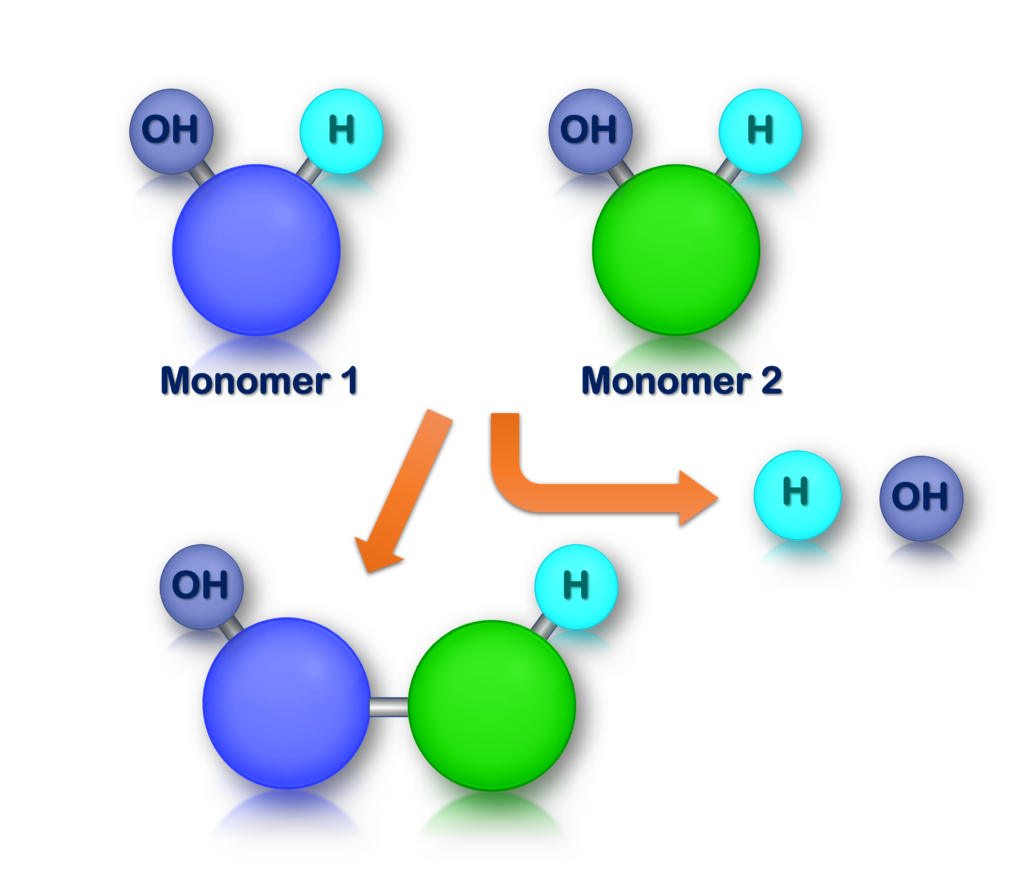
A defining feature: condensation polymers lose a few atoms from the original monomers as that byproduct leaves. Addition polymers (like polyethylene) don’t — they’re built from unsaturated monomers that simply open up and join with nothing left over.
What you end up with depends on how many reactive “hooks” (functional groups) each monomer has. A monomer with only one reactive group caps off a chain, keeping molecular weight low. Two reactive ends give you straight, linear chains. More than two, and the chains start tying into a three-dimensional, cross-linked network.
A common route is dehydration synthesis, which joins monomers carrying an –OH (hydroxyl) group and a loosely held –H at their ends (such as a hydrogen from the –NH₂ group in nylon or in proteins).
Usually two different monomers are involved; the bonds break so that the –OH and the –H come off together as water, leaving the polymer behind. Polyester, for example, forms through ester bonds between a carboxyl group and a hydroxyl group (an organic acid and an alcohol). Nylon forms by reacting diamines with carboxyl derivatives — a dicarboxylic acid, or sometimes a diacyl chloride — or by reacting monomers that carry both an amine and an acid group on the same molecule.
One more thing worth knowing: unlike addition polymers, condensation polymers can be biodegradable. Their peptide or ester bonds can be broken apart (hydrolyzed) by acids or by bacterial enzymes, snipping the long chain into smaller pieces. In general, condensation polymers form more slowly than addition polymers, often need heat, and tend to have lower molecular weights. The monomers get used up early, the chain ends stay reactive throughout, and short pieces keep merging into longer ones — and reaching truly high molecular weights requires a very high conversion rate, as described by the Carothers equation.
One Idea, a World of Materials
Strip away the terminology and the whole story is really one simple idea repeated at enormous scale: small molecules linking into giant chains. Change which bead you start with, how many you string, and how you join them, and you can engineer a material to be soft or rigid, clear or opaque, disposable or built to last for decades. That single, flexible idea is why polymers show up in almost everything around you — and why understanding them is the first step into one of the most useful fields in modern science and industry.