
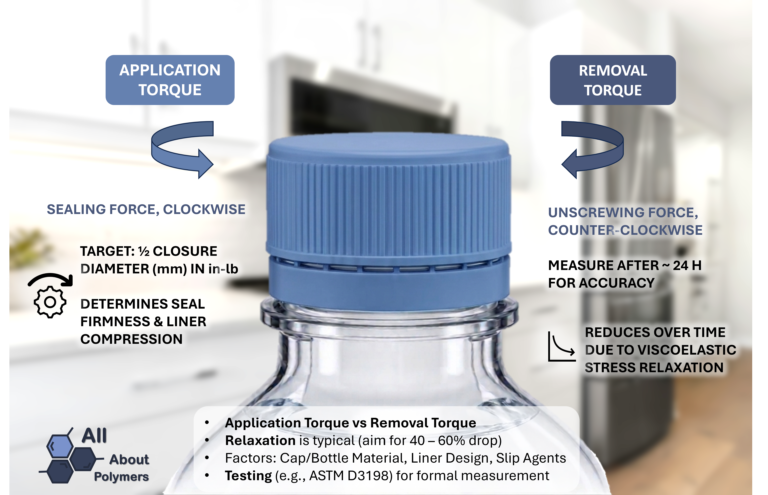
You open a bottle of shampoo, a jar of jam, or a bottle of water many times a week, almost without thinking about it. But behind that simple twist sits a carefully engineered value: torque. When it’s right, the package stays properly sealed through shipping and storage, and it still opens the way it should. When it isn’t, you end up with leaks, or a jar nobody can open.
If you work with containers and closures, understanding torque is essential.
But what is torque?
In physics and mechanics, torque (also called moment of force) is the rotational counterpart of linear force. A linear force is a push or a pull that moves an object in a straight line. Torque is a twist that makes an object turn around an axis.
Strictly speaking, torque is not a force. It is a force multiplied by the distance from the axis to the point where that force is applied (the lever arm):
Torque = Force × Lever arm
That’s why a long wrench loosens a stubborn bolt more easily than a short one. You apply the same force, but farther from the axis, so you get more torque.
For a container, the axis is the center of the neck, and the lever arm is the radius of the cap. The torque decides how firmly the cap ends up screwed onto the container, and that one number shapes how the whole package performs.
Units. In the packaging industry, closure torque is usually given in inch-pounds (in-lb or lb·in). The SI unit is the newton-metre (N·m), and you may also see kgf·cm on equipment in Latin America. 1 in-lb ≈ 0.113 N·m ≈ 1.15 kgf·cm
Application torque: how tight the cap goes on at capping
Application torque is the twisting force a capping machine (or a person) uses to tighten a closure onto a container. It is set through the settings of the capping head, typically with a slip clutch or a servo motor. It determines how well the cap is seated and how much the liner or sealing feature is compressed against the container opening.
If the capper delivers the same torque to every bottle, every bottle gets the same seal.
Removal torque: how easily the consumer can open it
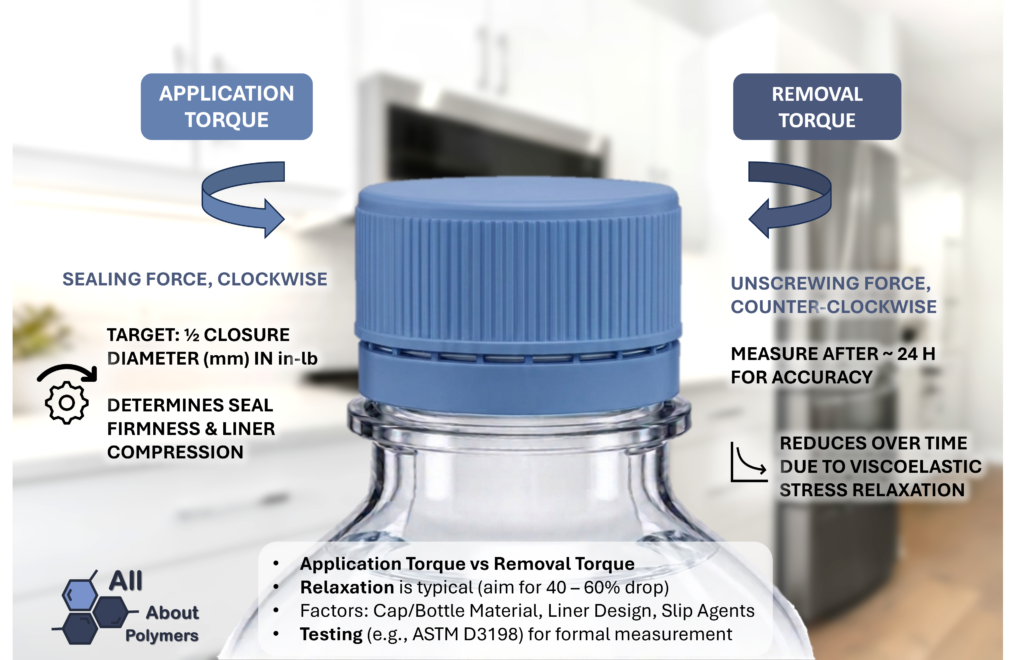
Removal torque is the twist needed to unscrew the cap and open the container. It is always lower than the application torque, because at capping, the cap, the liner and the cap threads are all left under stress.
Plastics are viscoelastic, which means that under a sustained load, their long molecular chains slowly slide and rearrange to relieve tension. This is called stress relaxation. Imagine a tightly pulled beaded necklace that slowly loosens as the beads settle into place. So over the first hours after capping, the cap holds less and less of the torque it was closed with.
For this reason, removal torque is usually measured after a waiting period, typically about 24 hours. That measurement tells you much more about the real, final seal than the machine setting alone.
As a general industry guideline, removal torque is about 40% to 60% of the application torque.
A handy rule of thumb
Several packaging-industry sources, including closure distributors, equipment makers and trade publications, quote and use this rule of thumb as a starting point:
Application torque (in-lb) ≈ ½ × closure diameter (mm)
Ejemplo: una tapa de 24 mm se aplicaría a unas 12 lb·in, y se esperaría un torque de remoción de unas 6 lb·in.
Keep in mind that this is a rule of thumb of the trade, not a precise or scientifically derived value. It doesn’t come from an engineering calculation or a testing standard, and it doesn’t account for the liner, the resins, slip agents or the thread design. Closure suppliers publish their own recommended ranges, and the final value should always be confirmed by testing your specific cap–container combination.
What changes the torque you need?
There is no single correct torque for every package. Several factors move the target up or down.
- Cap size. Larger caps usually need more torque to compress the liner evenly over a larger sealing surface.
- Liner and seal design. Foam liners, molded-in or assembled seal liners, and linerless designs (plug seals or sealing lips molded into the cap itself) each compress and grip differently.
- Closure material. Polypropylene (PP), high-density polyethylene (HDPE) and, in some cases, especially in decorative parts, ABS each behave differently.
- Slip agents. Many PP and HDPE closures, as well as EVA liners, contain slip additives. These work as internal lubricants. Fatty acid amides such as erucamide or behenamide are mixed into the resin and gradually migrate to the surface of the cap or liner (a phenomenon known as blooming), where they form a thin lubricating layer. Slip agents reduce friction between the cap and the neck threads, and between the liner and the top of the neck (the sealing surface). This lowers both application and removal torque, and makes removal torque more uniform from cap to cap. Because migration depends on time and temperature, the age of the caps and their storage conditions can also affect torque results. For sensitive products like bottled water, saturated amides such as behenamide are often preferred over erucamide, for better control of organoleptic properties.
- Container material: glass or plastic. Glass threads are rigid and keep their shape, so the cap can be tightened firmly without distorting the neck. Plastic necks are more flexible, and their threads can compress or deform slightly under load. With plastic containers, over-tightening can distort the container opening, so the torque window has to be chosen carefully. Friction also changes: a PP cap doesn’t slide the same way on glass as it does on PET or HDPE. That’s why supplier torque charts give different values for glass and plastic containers.
Too little torque causes leaks and caps that loosen with vibration during shipping.
Over-tightening does not guarantee a better seal. Too much torque creates uneven pressure points and can damage the very parts that do the sealing.
How is torque measured?
Torque is measured with a torque tester, an instrument that holds the container firmly and records the torque needed to tighten or unscrew the cap. Manual torque testers are common in the lab and for hand capping. Automated testers remove operator variation on high-speed lines.
The reference test method is ASTM D3198, Standard Test Method for Application and Removal Torque of Threaded or Lug-Style Closures. It is used to rate the performance of automatic cappers, to check whether closures tend to loosen during storage or shipping, and to measure the torque needed to break or strip a closure.
Because application torque can’t be measured directly on most automatic cappers, regular removal-torque checks are how a packaging line confirms its cappers are doing their job.
To learn about polymers, chemistry, and more, visit us at: www.allaboutpolymers.com
Our Books: https://allaboutpolymers.com/our-books/
#Polymers #ChemicalEngineering #Packaging #Closures #MaterialsScience #AllAboutPolymers #PackagingEngineering #Plastics #Viscoelasticity
References
- The Cary Company, Torque Guide (separate glass and plastic torque charts).
- ASTM D3198 – Standard Test Method for Application and Removal Torque of Threaded or Lug-Style Closures. ASTM International.
- O.Berk, How To Make Sure Your Cap Is Tight Enough? – Packaging Crash Course (rule of thumb; removal torque at 40–60% after 24 h).
- Packaging World, Troubleshooting Continuous-Thread Closures (24 mm example: 12 in-lb application, 6 in-lb removal).