A Realistic Starting Point
Whether we like it or not, plastics are part of modern life. They turn up in nearly everything around us.
We’ve come to depend on plastic so heavily that sustainability efforts built around banning it outright simply aren’t realistic. A better path starts in basic education: first learning to separate glass from aluminum from cardboard and then learning to identify and separate the different types of plastic.
And here’s something important: a plastic being recyclable doesn’t mean it actually gets recycled. A lot of that comes down to education, at every age — adults, children, and older adults all play a part. If the most-recycled plastics in your community are PET polyester, polyethylene (PE), and polypropylene (PP), it’s worth making a special effort to separate those from the rest of the trash so they’re handled correctly.
Below we’ll look at how plastics are classified and touch briefly on the methods used to recycle them. If you want the subject in full detail, see our Plastics Recycling book.
“The same object can be made from different plastics. Take a fork — the flimsy one that snaps after a single use is polystyrene, while the sturdier one you can wash and reuse over and over is polypropylene.”
How plastics are classified
You’ve seen the little numbered triangle stamped on the bottom of a bottle or a yogurt cup thousands of times. Almost nobody knows what it actually means — and, just as importantly, what it doesn’t.
That symbol is the Resin Identification Code (RIC), introduced by the Society of the Plastics Industry in 1988 and now maintained under the standard ASTM D7611. It exists because, before anything can be recycled, items have to be sorted by the material they’re made from — and the code assigns a number from 1 to 7 to the most common plastics so they can be told apart.
Originally the triangle was drawn as the “chasing arrows” symbol, which ASTM later replaced with a plain solid triangle, precisely because the arrows were so often misread as a recycling promise. That’s the key thing to understand up front: the number identifies the resin, not whether the item is actually recyclable. It only tells you which family of plastic you’re holding.
1 — PET (polyethylene terephthalate)
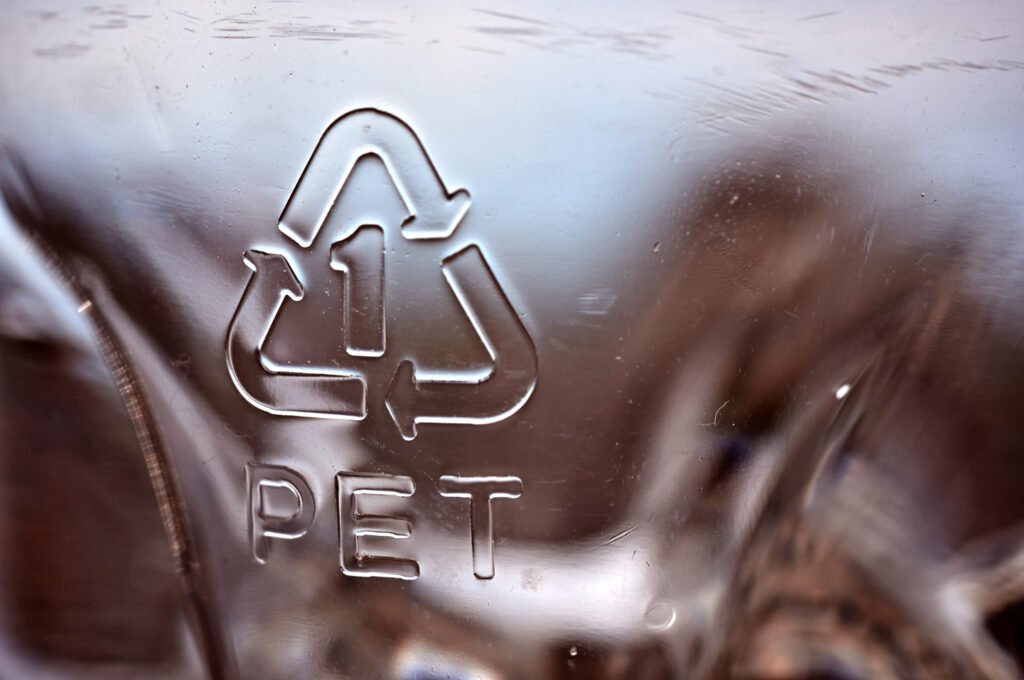
If you’re holding a clear water or soda bottle right now, you’re almost certainly holding PET. It’s a polyester, and it’s the material behind nearly every beverage bottle, along with many clear clamshell containers — the kind berries and pastries come in. It carries the number 1 because it’s the most recycled material in the world — though not necessarily the most recyclable. PET is highly hygroscopic, meaning it absorbs moisture from the air very readily, and that moisture has to be driven off before processing or the material degrades. So, it’s trickier to handle than its popularity might suggest.
2 — HDPE (high-density polyethylene)
Picture the opaque plastic milk jug in the fridge, or a shampoo or laundry-detergent bottle — that’s almost always HDPE. It also turns up in rigid packaging and toys. After PET, HDPE — together with polypropylene and low-density polyethylene — is among the most recycled plastics worldwide. It’s actually easier to recycle than PET, because it isn’t hygroscopic and its density is below 1.
3 — PVC (polyvinyl chloride)
PVC is the chameleon of the group: the soft shower curtain in your bathroom and the rigid card in your wallet are both PVC. Formulated flexible, it becomes tarpaulins, shower curtains, tablecloths, and even the foam in shoe soles and other footwear parts. Formulated rigid, it becomes bottles, large water jugs, credit cards, pipe, and profiles. It can also be loaded with a large amount of plasticizer to form a plastisol, a liquid PVC paste that’s later fused with heat into a flexible solid.
PVC’s recyclability depends entirely on where it comes from:
• Post-industrial PVC — the scrap generated inside a factory during manufacturing — is one of the easiest plastics to reuse. It’s clean, of known composition, and goes straight back into the process, so there’s practically no wasted material.
• Post-consumer PVC is a very different story. It’s one of the harder resins to recycle at end of life, because the chlorine content, the plasticizers, and the wide variety of additives and contamination make reprocessing complicated.
4 — LDPE (low-density polyethylene)
This is the flimsy-bag plastic: bread bags, sandwich bags, produce bags, plastic cling wrap, trash bags, etc. It’s kept separate from HDPE because these general-purpose bags are made from LDPE. Some bags contain a little HDPE, but that doesn’t cause much trouble when recycling LDPE products.
5 — PP (polypropylene)
Think of the caps on soda and water bottles, the screw-top jar a face or body cream comes in, drinking straws, microwave-safe food containers, and the sturdier disposable plates and cutlery — the sturdy kind you can wash and reuse — plus mechanical parts like gears. That’s polypropylene. Alongside HDPE, PP is one of the most recycled plastics in the world.
6 — PS (polystyrene)
If you’ve ever sipped from a foam cup or eaten with the clear plastic forks at a party — the brittle kind that snap after one use — you’ve handled polystyrene. And remember the yogurt cup from the top of the page? That’s mostly PS as well, though some brands use other plastics. The category covers both PS and high-impact polystyrene (HIPS), and it goes into disposable cups and plates, fast-food containers, and rigid disposable packaging.
Expanded polystyrene (EPS) — known across Latin America as unicel and loosely in the US as “Styrofoam” — is chemically still polystyrene, and many producers mark it with a 6 on the bottom. But it has to be kept apart from solid (un-foamed) polystyrene, because the process to recycle it is more complicated and completely different. (A note for accuracy: “Styrofoam” is really a trademarked extruded-polystyrene insulation product; the foam cups and coolers people call Styrofoam are technically EPS.)
7 — Other
This is the junk drawer of the system — everything that doesn’t fit the first six. The big five-gallon water-cooler jug (polycarbonate), an old CD or DVD (also polycarbonate), a sheet of clear acrylic, or a foil-lined juice pouch made of several materials at once all land here. That’s the system’s main weakness: with only seven categories, there’s no simple physical way to tell, say, an acrylic from a polycarbonate just by looking at it.
“A good education can solve sorting. Once you know the brittle fork is PS and the bendable, washable one is PP, you can tell them apart.”
Some of these “other” plastics are especially valuable, though, because they can be turned back into useful chemical raw materials. A special group, the depolymerizable plastics, can be converted right back into the monomers they were originally built from. Polymethyl methacrylate (PMMA, or acrylic), polyamide 6 (PA6, or nylon 6), and polylactic acid (PLA) are well-known examples.
This is the one place our beaded-necklace picture still fits: recycling most plastics is like restringing whole necklaces into new ones, while depolymerizing these is like taking the necklace fully apart and recovering the individual beads to use again.
There’s one more complication worth naming, and it ties back to where we started: the same object can be made from different plastics. Take a fork — the flimsy one that snaps after a single use is polystyrene, while the sturdier one you can wash and reuse over and over is polypropylene. They look almost identical, which is exactly what makes sorting so hard. But it’s also exactly what good education can solve: once you know the brittle fork is PS and the bendable, washable one is PP, you can tell them apart in seconds. That small skill, multiplied across millions of people, is what turns sorting from a bottleneck into something that actually works.
The recycling process
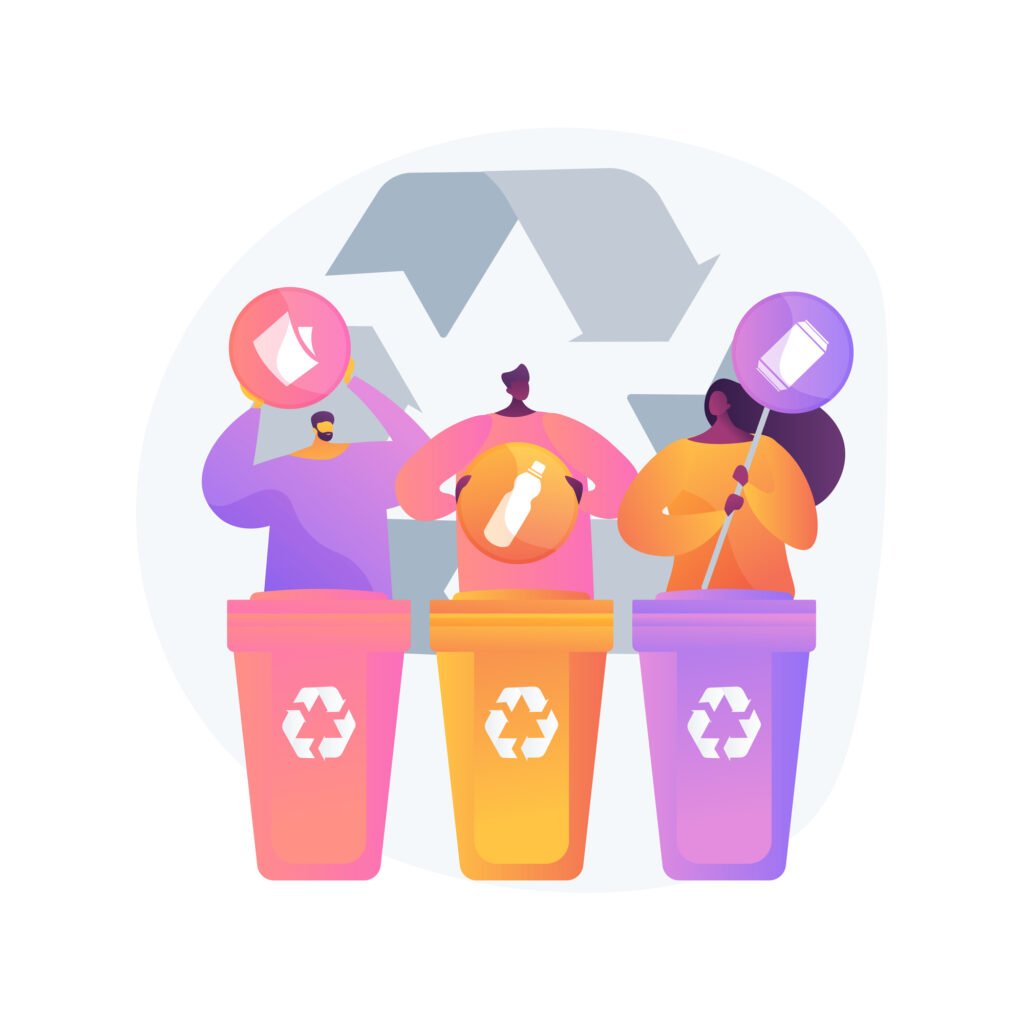
Recycling is one of the most effective ways to reduce environmental impact and the depletion of resources. By cutting the energy and raw material needed per unit produced, it raises overall eco-efficiency. It’s also the final result of several intermediate stages: collection, sorting, and processing.
Right now, recycling is the most efficient tool we have for easing the environmental problems caused by accumulated plastic waste from everyday products. Because most plastics are made from oil and gas, recycling helps conserve natural resources. It keeps waste out of landfills — and out of the soil, air, rivers, lakes, seas, and oceans, where indiscriminate dumping spreads disease and contamination. It also lowers oil consumption and carbon dioxide emissions, and it remains one of the most dynamic areas of the entire plastics industry.
In practice, plastics recycling covers:
• Collecting any plastic piece
• Sorting and separating products by type of plastic
• Grinding the pieces into manageable particles
• Cleaning
• Forming granules or pellets
• Using those pellets to make new products
It sounds simple written out like that. In reality, each of these stages is an enormous job, handled by different highly specialized players all along the chain.